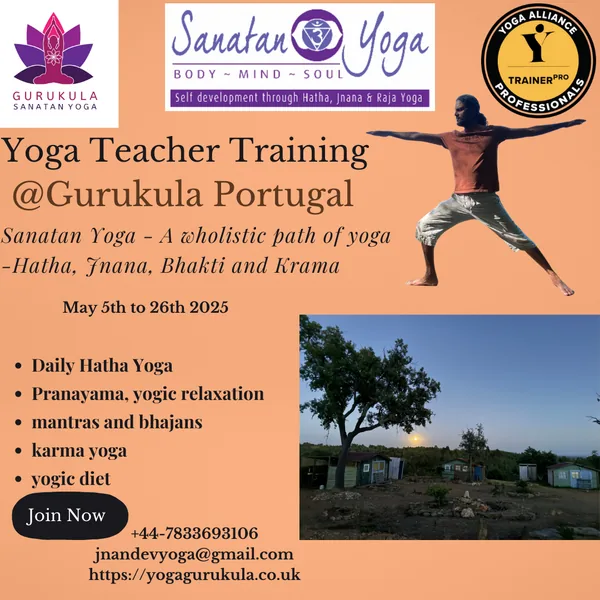
200 Hours Intensive Yoga Teacher Training
Cebolais de Cima, Castelo Branco District, Portugal
May 5, 2025 @ 4:00 AM → May 26, 2025 @ 8:20 PM (your time)
Why you should attend:
200hours Foundation Yoga teacher training – This is level 1 Yoga Teacher Training course in Sanatan Yoga. This course includes various sets of classical Hatha Yoga from beginners to advance level for physical, mental, emotional and spiritual well-being. Further you will first series of Pranayamas of Gitananda Tradition to prepare your pranic energy system, mind, nervous system and chakras for further advance practices. We will follow a set of mantras and bhajans as part of our mind and chakra purification and awakening. We will also study history and meaning of yoga followed by study of ashtanga or raja yoga, pancha-kosha, nadis, chakras and key yogic concepts.
Objective – To enable Yoga Teacher Trainees to be able to teach Sanatan Yoga Classes and Workshops as well as design Hatha Yoga Sadhana routines.
-Understanding classical roots and principals of Yoga, Ashtanga Yoga -eight limbs of Yoga, pancha-kosha, and chakras.
Outcome – Become a successful Sanatan Yoga Teacher to design your own yoga sadhana routines and teach hatha yoga at various levels.
Is this course for you? – IF you are looking to teach classical or authentic hatha yoga and learn the philosophy, ideas and principals behind yogic practices and philosophy, then yes, this yoga teacher training course is for you.
How much does this course costs- Prices start from 2000 euros, Depending on accommodation you chose @ Gurukula, Home of Sanatan Yoga Sadhana & Education, Portugal.
How Long does it take to complete the 200hrs foundation yoga teacher training course in Sanatan yoga? This course takes 24 days residential yoga sadhana, learning and practice at ashram and you will have excess to our online audio-video course materials for 6 months.
Course Outline –
Hatha Yoga - 11 Plus Sets of Hatha Yoga – including jattis, kriyas, asana, pranayama, mudra and bandhas. (each one of them will be practised as 1 hour session and 1.5 hrs session)
• Hatha for beginners and general health-A simple and progressive lesson plan to introduce people into holistic hatha yoga to gain general health and well-being.
• Hatha Yoga for Breathing- Hathenas to improve sectional breathing, enhancing quality of prana and energy, mind-emotion cleanse. Hathenas and Vedic Suriya Namaskar.
• Hatha Yoga for flexibility, strength, and vitality. Chatus-Pada Kriyas followed by Aruna, Vedic, Rishikesha Suriya Namaskar.
• Hatha Yoga for Balance, vitality and Harmony- Hatha Yoga series to balance right-left, loma-viloma, sun-moon energies to bring balance, and improve immunity. (Aruna Suriya Namaskar Extended 2 sets)
• Activation of Pranic Energies and channelling them for better health and well-being. Kshatriya Kriyas, Vajra-veera and Vajrasana supta.
• Classical Approach of Hatha Yoga – Static poses, bandhas and mudras for physical, mental, emotional, and spiritual development.
• Teaching Skills or understanding lesson planning. Lesson plans- 1. Self- Healing, 2. Gentle work-out, energy balance, and vitality, 3 advance hatha yoga for prana-apana union.
• Assessment.- students led sessions.
Applied Yoga Philosophy
• Introduction and meaning of yoga in various context- Yoga has so many meanings, definitions as it all depends on what you are seeking out of yoga. It can be seen as tools to keep fit physically, others can see it as tool to relax, stay calm, or can see it as tools to concentrate and meditate. In this chapter we will explore various meanings and definitions of yoga in various contexts and scriptures.
• History and Development of Yoga- Yoga has evolved, transformed. Yoga used be for few of those seeking for enlightenment in Ancient India where the Guru will look for a disciple who is qualified to learn yoga. While in modern times yoga is easily available and accessible to everyone. Yoga has also devolved as in modern times many are using term yoga as a fashion and brand to teach all the keep fit exercises. In this section we will explore how yoga has transformed from ancient to modern times.
• Importance of Sanskrita in Yoga – In this chapter we are going to look into roots and importance Sanskrita language and learn some basic terms to enhance our understanding and use of some Sanskrita terms in our practice and teaching.
• Guru-Shishya Relationship and our Lineage
• Raja Yoga or Ashtanga Yoga- Raja Yoga or Ashtanga Yoga is highest form of yoga as a path with tools to deal with our physical, mental, emotional, spiritual and karmic issues and various states as we grow and evolve. In this chapter we aim to understand steps of raja yoga as a life path.
• The many Paths of Yoga- Yoga has many paths, approaches and tools like jnanas (wisdom), dhyana (meditation), karma (action), bhakti (devotion), etc. In this chapter we will try to explore these overlapping paths and practices in yoga.
• Obstacles in Sadhana and tools to deal with them.
• Key Yoga Scriptures- In this section we will study history, roots, key ideas, and practices of key yoga scriptures – Yoga Sutras of Patanjali, Bhagavat Gita, Gheranda Samhita, Hatha Yoga Pradipika, Shiva Samhita, Yoga Vashistha and Vijnana Bhairava Tantra.
• Pancha Yamas and Niyamas- In this chapter we will discuss on basic moral and ethical discipline and understand their practical importance in overcoming our animal behaviour problems driven by our desires and emotions.
• Pancha Yamas- We will go into further detail to understand Ahimsa (non-violence), Satya (truth), Asteya (non-stealing), Brahmachariya (energy discipline), and Aprigraha (non-greed).
• Pancha Niyamas- Niyamas are code of conducts on how to live as a good human being and evolve on the authentic yoga path. In this chapter we aim to understand universal concepts concepts of first two niyamas- Saucha (cleansing) and Samtosha (contentment).
• Asana- Asana is third limb and very well explored and known in modern yoga. In this chapter we will look into asana and its meaning in various contexts and its importance and benefits in modern times.
• Asana and Pancha Kosha- In this chapter we will explore five body concept of yoga in compare to one body concept of modern science and understanding yoga in holistic health and well being.
• Key concept of Hatha Yoga – In this section we will explore key concepts of hatha yoga like Ha-Tha, Loma-Viloma, Shiva-Shakti, Prana-Apana, Spanda-Nispada, Adhi-Vyadhi, Nadis and Chakras etc.
• Pancha Prana, Naris and Kundalini- Prana is subtlest form of cosmic energy, which is all pervading and all sustaining. Whole universe evolves from this pranic energy. This energy evolves in various forms to sustain various activities in and around us. In this chapter we explore on concept of pancha prana and importance of its understanding in day to day life.
• Pranayama– The science of our vital energy or force that give us life and vitality. Pranayamas are practiced though breath work, but the breath-work is not the aim, it is to control our prana.
• Karma and Evolution- Samaskaras are deep ingrained behaviour patterns. Karma is our action on physical, mental, emotional and spiritual level. In this chapter we try to explore and understand concepts of Karma and choices we make leading us into many unconscious karmas and Samskaras.
• Pratyahara, meaning and importance- Pratyahara is fifth limb of raja yoga, which means sensory withdrawal. In this chapter we study about senses in modern and ancient concepts of yoga and Upanishads and explore the ways to discipline them.
• Dharana or Concentration and Dhyana or Meditation-Patanjali says that concentration is ability of our mind. In this chapter we study 6th and 7th limb of ashtanga yoga and explore various tools and practices.
• Dhayana and Samadhi- These are 7thand 8thlimbs of raja yoga means meditation and enlightenment. In this chapter we continue from concentration or dharana and explore further deeper.
• Revision
Pranayama
• Savitri Rhythm and Sukha Purvaka Pranayama- Solar rhythm and easy but rhythmic breathing is a nice and gentle way to introduce into pranayama practices. These are to help balance and activate our energies and harmonize our body, mind and emotions together.
• Suriya and Chandra Nari Pranayama-Sun and Moon nostril breathing is to help activate right and left sides of brain and find harmony in our day to day life.
• Vibhaga Pranayama - Sectional breathing.
• Pranava Pranayama- Pranava AUM pranayama is beautiful way to activate all three sections of our lungs and recharge our vital organs.
• Bhastrikas-Nine cleansing breathing techniques to get rid of negative energies on every level.
• Loma-Viloma Pranayamas for Polarity and Health
• Sukha Pranayamas with Pratyahara and Dharna concept.
• Anunashika Pranayama for cleansing nostrils and sinuses.
• Bhramari-Bhramara Pranayama for brain-nervous system activation and recharging.
Yoga Anatomy and Physiology
• General Anatomical Terms, cells, tissues, organs, systems and Yoga 2 hours
• Key Body Systems and Yoga
• Skeletal System and Yoga
• Muscles and Yoga
• Contraindications, yoga adjustments and key issues
• Respiration and Hatha Yoga
• Backbone, spine and Yoga.
Foundation Training Course
Offered By: